Online dating moves quickly.
A conversation starts. The chemistry feels promising. One message becomes twenty, plans come together, and suddenly you are getting dressed and heading across town to meet someone you have never met in person.
That momentum is normal. It is part of what makes dating exciting.
But there is still one useful question worth asking:
“What do I actually know about this person and tonight’s plans?”
That question does not mean assuming the worst. It means giving yourself a simple backup plan before excitement takes over.
Safety planning does not have to kill the mood
Traditional dating-safety advice can feel heavy:
- send screenshots to several friends
- share your location continuously
- arrange multiple phone calls
- explain every change of plan
- have someone actively watch your movements
Those approaches can help, but they can also feel intrusive, complicated, or easy to abandon.
A safety check-in offers a lighter option.
You decide:
- where you are going
- who you are meeting
- when someone should expect you to check in
- which trusted contact should be alerted if you do not
You remain in control. Nothing needs to happen unless you miss the agreed check-in or indicate that you need help.
What a useful dating safety session can include
Before leaving, take a minute to record whatever information you have:
- the venue or address
- the person’s name
- their dating profile
- an expected finishing time
- transport plans
- any likely change of venue
- notes that may help your trusted contact understand the situation
The information does not need to be perfect. Its value is that someone has a starting point if your normal plan unexpectedly goes quiet.
See how MeetSafe safety sessions work for a simple overview of check-ins, checkouts, and trusted contacts.
Privacy-first means no constant surveillance
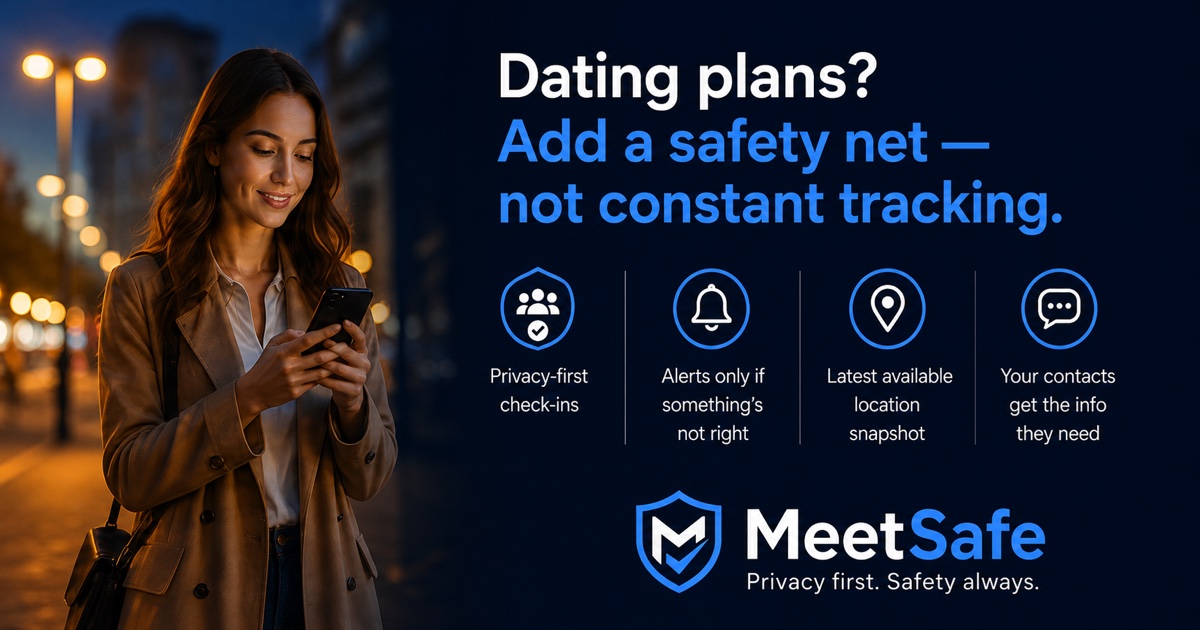
MeetSafe is designed around deadlines and check-ins — not somebody staring at a moving dot on a map.
Depending on the safety session, device, plan, permissions, and settings, MeetSafe may provide limited location context where available. It is not designed as constant tracking or a live map.
Where available and enabled, that context may be shown as the latest available location snapshot, together with “captured at” and “accuracy approximately” details. Location is useful context rather than the only safety mechanism, and it is not included in every safety session.
Nobody needs to monitor the entire date. Someone just needs to know when silence has become unusual.
What happens if a check-in is missed?
MeetSafe prompts you to check in.
If the check-in remains unresolved, your chosen trusted contact can be alerted. They can then try to call or message you and decide what action is appropriate based on the information available.
MeetSafe is not emergency services and cannot guarantee delivery, response, or rescue. It is one practical layer within a sensible personal-safety plan.
Good chemistry and good planning can coexist
Setting a safety session does not mean you distrust the person you are meeting.
It means you understand that online chemistry is not the same as knowing someone in real life.
You can be spontaneous.
You can follow the momentum.
You can enjoy the date.
You can also take sixty seconds beforehand to make sure someone knows when you are expected to be okay.
Before your next meetup
- Tell someone where you are going.
- Add the details you currently know.
- Choose a realistic check-in or checkout time.
- Update the safety session if plans change.
- Check in when prompted.
Good chemistry is great. A safety plan is smarter.
Learn more about MeetSafe’s privacy-first approach, or add a practical safety net before your next meetup.
Download MeetSafe on iPhone or Android.
Privacy first. Safety always.